


Every few months, someone publishes a new take on AI replacing financial advisors. The profession has heard some version of this argument before, from index funds, from robo-advisors, from online brokerage platforms. It keeps not happening. And in 2026, the data tells you exactly why.
Demand for financial advisors is at a recorded all-time high. The number of clients served by SEC-registered investment advisers climbed 7.7% to 73.7 million in 2025, while assets under management reached a record $176.8 trillion, according to the 2026 Investment Adviser Industry Snapshot published by the Investment Adviser Association and Comply. Those are not the numbers of a profession under existential threat.
The Profession Is Growing. Supply Just Can't Keep Up.
Here is the real tension in the advisor market right now, and it has nothing to do with AI replacing anyone. McKinsey estimates that the number of advised relationships will grow at least 28% over the next decade, from 53 million to at least 67 million by 2034. To meet that pace, the industry would need to grow headcount by 2.5% to 3% annually. Instead, advisor headcount is expected to shrink by about 0.2% per year.

Demand for professional financial guidance is growing faster than the industry can recruit and train new advisors.
The projected shortfall is meaningful. McKinsey estimates the advisor shortage will reach 90,000 to 110,000 by 2034. About 38% of today's advisor workforce, representing 42% of total industry assets, is expected to retire over the next decade. Retirements outpace new entrants by a wide margin.
The Bureau of Labor Statistics projects employment of personal financial advisors to grow 10% from 2024 to 2034, much faster than the 3% average across all occupations, with roughly 24,100 openings per year over that period. That growth projection comes specifically from rising demand, not just replacement hiring.
You do not face a 100,000-person shortage in an occupation that automation is about to render obsolete.
Why the Role Itself Is Hard to Automate
The misconception worth pushing back on is that financial advising is fundamentally a set of analytical tasks, including portfolio construction, tax optimization, and retirement projections. It is those things, but that is not what clients are actually paying for.
A new Edward Jones and Morning Consult study found that 82% of financial advisors already use AI in their practice, and most say it makes their work more human, not less. In the same research, 68% of advisors said building and maintaining long-term client trust requires a human touch. Nearly all advisors, 97%, reported that client conversations have expanded well beyond traditional investing topics to include wealth transfer, financial anxiety, life decisions, and broader economic concerns.
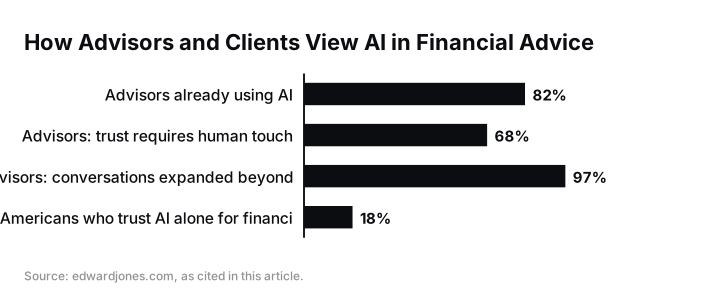
How Advisors and Clients View AI in Financial Advice
That expansion of scope is important. When a client calls their advisor in a volatile market, they are not looking for a portfolio rebalancing algorithm. They are looking for a person who is completely independent from their financial situation, someone who can hold their financial life at arm's length and make clear-headed decisions on their behalf. An AI agent managing your money still requires you to be responsible for it, through a proxy. That does not solve the problem an advisor actually solves.
The function a financial advisor serves goes well beyond the individual tasks they perform. Clients delegate emotional and financial authority to a trusted professional precisely because that professional is separate from the money. That separation is the product.
Despite growing AI adoption in the industry, only 18% of Americans would trust AI to make financial recommendations on its own. The human relationship remains what clients are buying.
Advisors Who Embrace AI Will Pull Ahead
None of this means the profession stays static. Advisors who use AI to handle the routine, including meeting prep, portfolio analytics, tax-loss harvesting models, and client email drafts, will have more capacity for the complex. That is a competitive edge, not a threat to the role itself.

Advisors who use technology to handle routine tasks can direct more energy toward the complex, relationship-driven work clients value most.
The advisors who will win business over the next decade are the ones who show up to client conversations with more bandwidth, not less. AI clears the administrative path so you can do more of the work clients cannot get anywhere else: behavioral coaching, life-transition planning, estate coordination, and the kind of accumulated judgment that comes from years of working with real people through real financial circumstances.
For advisors with a defined niche and a strong brand, this environment is about as favorable as it gets. The pipeline of clients who need professional guidance is growing faster than the pipeline of advisors to serve them. The question worth asking is not whether AI will take your clients. It is whether your marketing positions you to reach the clients who are actively looking for you right now.
We work closely with independent advisors every day, and our view of this profession is straightforwardly bullish. The data backs it up. If you are thinking about how to build your brand in a market where demand is outpacing supply, our team is happy to talk through what that looks like for your practice.
Common questions
Will AI replace financial advisors?
The evidence in 2026 points clearly toward no. Clients served by SEC-registered advisers reached 73.7 million, a record high, and a McKinsey analysis projects the U.S. will face a shortage of 90,000 to 110,000 advisors by 2034. AI is changing what advisors do at the task level; it has not reduced demand for the role itself.
The core function advisors serve (providing independent judgment, behavioral coaching, and trusted decision-making on behalf of clients) remains deeply human. Only 18% of Americans say they would trust AI to make financial recommendations on its own, according to a 2026 survey.
Is there a financial advisor shortage?
Yes, and it is well-documented. The advisor workforce has grown at just 0.3% annually over the past decade, while demand continues to increase. About 38% of today's advisors are expected to retire within the next decade, and the industry needs 2.5% to 3% annual headcount growth just to keep pace with rising client demand, a gap that is widening, not closing.
How are financial advisors using AI in 2026?
According to Edward Jones and Morning Consult research published in 2026, 82% of financial advisors already use AI in their practice. Most report that it makes their work more human, not less, primarily by automating routine analytical tasks so advisors can spend more time on the relationship and judgment-driven work that clients value most. The advice itself, along with fiduciary accountability, stays with the human advisor.