

advisor marketing
Alts Are Picking up Steam: Marketing Guide for a Shifting Market
Capital Turbine · · 10 min read

Your clients and prospects are hearing about alternative investments everywhere right now, and most of them don't fully understand what they're hearing. A Deloitte survey of roughly 1,000 retail investors, published October 13, 2026, found that as many as three in four are open to investing in private equity, venture capital, private credit, and asset-backed finance. That same survey found that 80% of retail investors have an investment horizon under five years for non-retirement assets, a fundamental mismatch with how most alternatives are structured. That gap between interest and understanding is exactly where your content marketing earns its keep.
What Changed, and When
The regulatory picture shifted fast in the second half of 2026. On September 30, 2026, the SEC voted unanimously to propose two sets of rule amendments designed to expand retail investor access to private markets. The package (which SEC Chairman Paul Atkins described as "responsible retailization") would modernize the interval fund structure, expand when registered investment advisers may charge performance-based compensation across retail fund products, and open new pathways for individuals to qualify as accredited investors.

Regulatory shifts and market growth are reshaping which investment options are available to everyday investors.
Those proposals build directly on an August 2025 executive order directing the Department of Labor to reexamine its fiduciary guidance on ERISA and clarify when plan fiduciaries can prudently offer asset allocation funds that include alternatives. In practical terms, that means defined contribution plans (the 401(k)s your clients use every day) are being considered as a vehicle for private market exposure in a way they never have been before. For context on how early this still is: according to the 2026 Defined Contribution Plan Benchmarking report, only 2.9% of DC plans currently offer alternative asset classes to participants.
The market itself has grown dramatically regardless of what regulators do next. Private credit markets have grown from a small fraction of their current size in the years before the financial crisis to a multi-trillion-dollar asset class today. Global alternative assets under management exceeded $33 trillion in 2025. These aren't niche numbers. They're the backdrop for conversations your clients are already having with colleagues, family members, and their own Google searches.
Where Retail Adoption Actually Stands
Two data sets help put the current moment in context. The first is how alternatives adoption scales with investor wealth. A Goldman Sachs Asset Management survey of high-net-worth investors found a sharp jump in usage as account size grows:
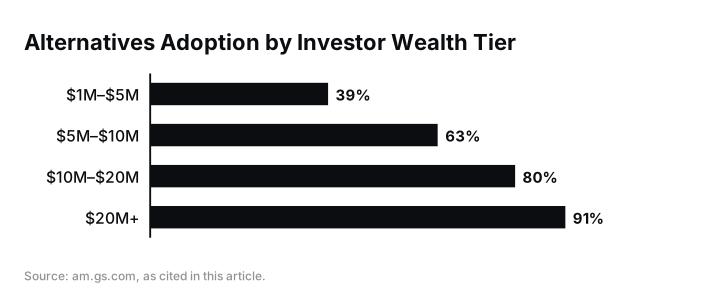
Alternatives usage climbs at each wealth tier, showing the gap between mass-affluent and ultra-high-net-worth investors.
The pattern is clear: alternatives adoption rises sharply with higher net worth, with 39% of investors with $1–5 million reporting use of alternatives, rising to 91% for those above $20 million. If your practice focuses on the mass-affluent or emerging-HNW segment, these clients are watching wealthier peers use alternatives and are increasingly asking why they can't access the same options. Your content can answer that question and position you as the advisor who's already thinking about it.
The second data point is on the advisor side. According to a CAIS and Mercer survey, nine in 10 financial advisors (92%) currently incorporate alternative investments in client portfolios, with 91% planning to increase allocations over the next two years. Five in 10 advisors now allocate over 10% of client portfolios to alternatives. That means the advisors your prospects compare you to are already in this conversation. Your marketing should be, too.
The Education Gap Is Your Opening
Here's the specific dynamic worth understanding before building any content around this topic. The Deloitte survey found that roughly 30% of retail investors open to alternatives said they would consider an investment if recommended by an investment adviser, a sizable group of persuadable prospects who are waiting on someone they trust. At the same time, the research showed retail preferences clash with product structures: investors rank illiquidity risk among their top concerns, yet many of them don't fully understand how liquidation caps or redemption windows actually work.

Curious investors are looking for a trusted voice to explain alternatives clearly and honestly.
That tells you something concrete about the content you should be producing. Your audience wants to understand alternatives, and they're looking to an adviser, potentially you, to help them get there. The educational gap is real, it's measurable, and it's a content opportunity that most advisers still aren't filling well.
Deloitte explicitly recommends that advisers and managers focus on investor education, alternative product structures, and strategic alliances to capture the expanding retail opportunity. That recommendation is aimed at the industry broadly. For you as an independent adviser with a defined niche, it's a specific mandate: be the clearest, most trustworthy voice on this topic for your ideal client.
What Content Actually Works Here
The advisers who win in this environment won't be the ones who post the most about alternatives. They'll be the ones who make the topic accessible to a specific audience over time. A few principles worth applying:

Advisers who make alternatives education a consistent practice are better positioned when clients bring up the topic.
Lead with the question your client is actually asking. "What even is private credit?" and "Can I get access to this in my 401(k)?" are better starting points than technical explainers on interval fund structures. Meet people where their curiosity starts, not where your knowledge peaks.
Explain the tradeoffs, not just the appeal. Alternatives carry real liquidity risk, complexity, and in many cases high minimums. Content that addresses these honestly builds more trust than anything that reads like a sales pitch. Investors who feel informed rather than sold are the ones who show up to meetings.
Tie your content to the news cycle. The SEC's September 30, 2026 proposals are a legitimate news hook. The August 2025 executive order on 401(k) access is another. Timely content that explains what a regulatory development actually means for a real person in your client's situation gets opened, shared, and remembered.
New product structures are also expanding access. Retail and high-net-worth investors now access alternatives through interval funds, evergreen structures, and non-traded BDCs. These vehicles have trade-offs worth understanding, including less liquidity than public market equivalents, varying fee structures, and complexity that can catch unprepared investors off guard. Your content should cover both what these structures enable and what investors need to watch out for.
Turning Content Into Meetings
Content on alternative assets is one of the more natural lead-generation plays in adviser marketing right now, because the topic is high-interest and low-understood. A few mechanics that tend to convert readers into calendar invites:

Email and educational content remain high-return channels for advisers covering complex topics like alternative investments.
First, every piece of educational content on alternatives should end with a clear, low-friction call to action, not "contact us," but something like "If you're wondering whether any of this applies to your current allocation, a short call can answer that." The Deloitte data shows that a large portion of curious retail investors are genuinely waiting for an adviser to make the first move.
Second, email is still the highest-ROI channel for this kind of topic. A well-segmented email series, "What's changing in alternative investments and what it means for you," sent to your existing client list keeps you front of mind and surfaces referral opportunities. Clients who feel informed by your content become advocates for it.
Third, social distribution matters here. LinkedIn posts that explain regulatory developments in plain language, what the SEC's interval fund proposals actually do, why the 401(k) executive order matters, consistently outperform general market commentary. They show expertise and attract prospects who are actively trying to understand this space.
The clients who ask about alternatives first are often your highest-potential prospects. Consistent, educational content makes sure they're asking you, not someone else.
The Deloitte Center for Financial Services has projected that alternative funds targeted to retail investors could grow by more than 50% CAGR to as much as $4.1 trillion by the end of the decade. Whether or not those projections prove accurate, the direction is clear enough that your clients will be hearing more about this category, not less. Your content strategy should reflect that reality before your competitors figure it out.
If you want to think through how to build this kind of content program for your practice, our team is happy to talk it through.
Common questions
What regulatory changes are making alternative investments more accessible to retail investors in 2026?
On September 30, 2026, the SEC voted unanimously to propose two sets of rule amendments designed to expand retail investor access to private markets. The proposals would modernize interval fund structures, expand performance-based compensation options for registered funds, and create new pathways for individuals to qualify as accredited investors. These proposals build on an August 2025 executive order directing the Department of Labor to clarify when retirement plan fiduciaries can include alternatives in 401(k) lineups.
Why do retail investors struggle with alternative investments even when they're interested?
A Deloitte survey of roughly 1,000 retail investors published October 13, 2026 found that while as many as three in four are open to alternatives, most have meaningful knowledge gaps. Illiquidity risk is a top concern, yet many investors don't understand how redemption caps or lock-up periods work in practice. Additionally, 80% of retail investors have an investment horizon under five years for non-retirement assets, a significant mismatch with the long-term, higher-minimum structures typical of institutional alternatives.
How should financial advisers use content marketing around alternative assets?
The most effective approach focuses on education over promotion. Advisers who explain what alternatives are, how new product structures like interval funds and evergreen vehicles work, and what the real tradeoffs look like, including liquidity constraints and complexity, tend to build more trust than those who lead with opportunity alone. Timely content tied to regulatory developments (like the SEC's September 2026 proposals) and distributed through email and LinkedIn tends to generate the strongest engagement and inbound meeting requests.
Sources
Deloitte survey found three in four retail investors open to alternatives but lacking understanding
SEC Chairman Atkins described the package as 'responsible retailization'
Only 2.9% of DC plans currently offer alternative asset classes to participants
J.P. Morgan Research: global alts AUM surpassed $33 trillion
CAIS–Mercer survey: 5 in 10 advisors allocate 10%+ to alternatives
This article is for educational purposes only and does not constitute financial, tax, or legal advice. Individual circumstances vary. Please consult qualified professionals for advice specific to your situation.