

advisor marketing
Your AUM Is Up. Your Client Count Isn't. Here's Why.
Capital Turbine · · 6 min read

Most RIAs are growing AUM right now without meaningfully growing their client base, and a lot of that gap comes down to marketing that doesn't differentiate them from thousands of other firms. Across more than 14,000 RIAs registered with the SEC in 2025 and 2026, the median firm boosted its AUM by 15% but increased its count of individual or institutional clients by just 2%, or one new customer over a 13-month period. The market moved AUM up. Marketing, for most firms, didn't move the needle on clients.
The Market Is Doing the Work You Think You're Doing
A strong run in equities is easy to mistake for business momentum. Assets go up, revenue goes up, and it can look a lot like growth. Until you look at the client count column.
The problem is that asset appreciation doesn't compound the way new client relationships do. Withdrawals and natural client runoff drive down firms' asset totals anywhere from 2% to 5% per year, according to Cerulli Associates. That's a steady drain that requires real organic growth to offset, not just a favorable market. If you're adding one client per year and losing a few to retirement distributions or estate events, the math isn't working for you regardless of where the S&P closes on December 31.
The firms that hold up well in tougher markets are the ones that have been consistently adding new client relationships. That requires marketing that actually reaches the right people, and that people can actually find.
We Looked at 4,705 Advisor Websites. Here's What We Found.
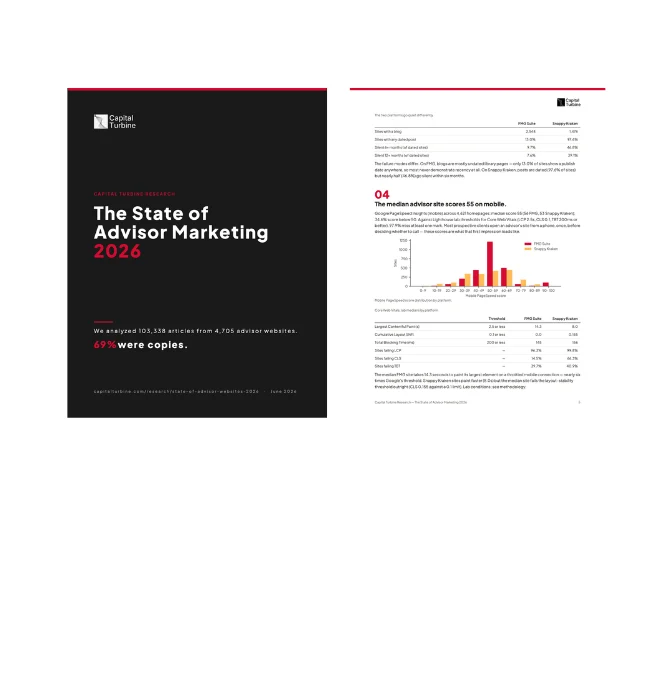
In June 2026, our team crawled and analyzed 103,338 articles and resources across 4,705 advisor websites built by Snappy Kraken and FMG Suite -- specifically those built on the two most widely used all-in-one advisor marketing platforms. We were looking at content duplication, publishing frequency, and mobile performance. The results were pretty striking.
68.8% of all articles and resources were exact matches of a page on at least one other advisor's website.
1,886 firms carry the single most-shared page, an FMG Suite-authored piece called "Simple 401k," word for word.
23.5% of sites with a blog have zero original posts. Every post on those sites appears somewhere else too.
50% of homepages contain at least one ten-word passage shared verbatim with 25 or more other firms.
40% of sites with dated posts haven't published anything new in six months.
To put a face on that last point: one homepage passage, "We want to learn more about your personal situation, identify your dreams and goals, and understand your tolerance for risk," shows up on 280 different firm websites. Your prospective clients have read it before. They'll read it again on the next firm's site after yours.
Mobile performance tells a similar story. The median mobile PageSpeed score across both platforms is 55. Google rates scores between 50 and 89 as "needs improvement," and more than a third of the sites we tested score below 50, which Google calls outright "poor." The typical FMG Suite site takes about 14 seconds to load on a phone.
Why This Matters for Search and AI Discovery
Search engines have always rewarded original, specific content over duplicated content. That hasn't changed. What has changed is that AI-powered answer engines (ChatGPT, Perplexity, Google's AI Overviews) are now a real part of how prospective clients research advisors. These tools pull from sources they identify as authoritative and distinct. A blog post that's byte-for-byte identical to 1,885 other versions of itself isn't going to be cited by any of them.
The practical result: when a prospect searches for an advisor who specializes in their situation, slow and duplicate-content sites don't surface. They find whoever has built something that actually stands out. Template platforms make it easy to have a website. They make it hard to be found.
This is a real trade-off that most advisors don't realize they're making. Shared-content platforms solve for compliance and convenience, and they do that reasonably well. What they don't solve for is differentiation, which is what search engines and AI systems actually need to point someone to you specifically.
This is one of the core downsides to syndicated content solutions like Snappy Kraken and FMG Suite.
Smaller Independent Firms Feel This Most
Larger firms have referral networks, brand recognition built over decades, and sometimes entire marketing teams. Smaller independent advisors are more dependent on being found organically: through search, through AI, through someone doing research on their phone at 10 p.m. before calling anyone.
That's exactly the scenario where a slow, duplicate-content site does the most damage. The prospect who would have been a great fit for your niche never gets to your homepage because your content didn't surface. Or they get there, read language they've seen a dozen times, and move on.
The path forward isn't complicated, even if it takes some work. Advisors who are adding new clients tend to have a few things in common: they have a clear niche and write about it specifically, their content reflects their actual voice and perspective, and their websites are built to load fast and be found. That's what makes someone call you instead of the next firm on the list.
If you want to see how your current site stacks up (how much of your content is shared with other advisors and where it's most and least original) our team can run a free site report for you.
Common questions
Why is AUM growing while new client counts are stagnant for most RIAs?
Mostly the market. Across more than 14,000 RIAs analyzed in SEC data from 2025 and 2026, the median firm grew AUM by 15% while adding just 2% more clients, roughly one new customer over 13 months. That gap reflects equity market appreciation, not organic growth. Attrition from withdrawals and client runoff runs at 2% to 5% of AUM per year, according to Cerulli Associates. Firms that aren't consistently adding new clients are exposed if market conditions shift.
How does duplicate content on advisor websites affect search and AI visibility?
When the same article appears on hundreds or thousands of advisor websites simultaneously, search engines have no basis to surface one version over another, so most of those pages rank for very little. Our June 2026 analysis found 68.8% of articles across 4,705 advisor websites built by Snappy Kraken and FMG Suite were exact duplicates of a page elsewhere. AI answer engines like ChatGPT and Perplexity have the same problem: they cite sources that are specific and authoritative, not content that's indistinguishable from thousands of other sites. Original, niche-focused content is what both search engines and AI systems reward.
What should independent advisors prioritize to improve organic client growth through marketing?
Three things tend to matter most: content that's genuinely yours (written in your voice, for your specific niche, not shared with thousands of competitors), a website that loads quickly on mobile (the median advisor site currently scores 55 on Google's mobile PageSpeed scale, which Google classifies as "needs improvement"), and a consistent publishing cadence. Forty percent of advisor sites with dated posts haven't published anything in six months. Advisors who get all three right give themselves a meaningful advantage in being found by the right prospects.
Sources
This article is for educational purposes only and does not constitute financial, tax, or legal advice. Individual circumstances vary. Please consult qualified professionals for advice specific to your situation.