

email campaigns for financial advisors
The Real Business Case for Advisor Email Marketing
Capital Turbine · · 6 min read

Most people who see your email are going to ignore it. Most people who see your ad are going to ignore it. The difference is that in one scenario, you're paying for them to ignore you, and in the other, you're not. That math alone makes email marketing the most overlooked asset in advisor brand-building, and it gets more compelling from there.
You're Already Paying to Be Ignored
Advisors who default to paid advertising aren't wrong about one thing: digital ads can build reach. But reach and awareness are not the same thing. When a prospect scrolls past your ad, you paid for that non-event. When a prospect glances at your email subject line and moves on, you paid nothing, and something still happened.
Seeing your name in the inbox is an impression. Opening the email is an intent signal. Clicking something inside it is a higher-intent signal. None of those require a conversion to have value, and none of them cost you anything per send once your list exists. Email marketing delivers an average return of $36–$42 for every $1 spent, making it the highest-ROI digital channel by a substantial margin, outperforming paid search ($2 per $1), social advertising ($2.80), and display ads ($1.35).
Compare that to paid advertising, which delivers an average 200% ROI, or $2 for every dollar spent. Email returns 12 to 15 times more per dollar than its nearest paid competitor. That gap has held for years.
Warm Audiences Are a Different Animal
Here's what the ads-first mindset misses. The people on your email list already know who you are. You have their permission. They gave you their address. That changes the math on everything, including how many touches it takes to stay relevant in their minds.

Every name in your inbox already knows who you are, and that changes everything about how you reach them.
The marketing "rule of 7," the idea that a prospect needs roughly seven exposures before your brand registers as memorable, applies primarily to cold audiences. A warm audience, one that has already opted in to hear from you, requires far less repetition to stay top of mind. A consistent weekly email to your existing list accomplishes that. Paid ads reaching cold traffic are doing a fundamentally different job: expanding your sphere of influence to people who have never heard of you.
These two channels aren't competitors. They serve different stages. Email keeps your existing sphere warm. Ads grow it. Running one without the other leaves money on the table, but if you're going to choose a starting point, start where your audience already is.
What the Numbers Say About Financial Services Specifically
Email performance in financial services runs above cross-industry averages. Open rates in financial services reach 20–35% for broadcast email, which compares favorably to the cross-industry average of roughly 17.8%. Email drives a conversion rate of 4.24%, while social media lags at just 0.59%. Per Litmus, 41% of marketing professionals rank email as their most effective channel, ahead of social media and paid search at 16% each.
Those numbers describe averages across all senders. Advisors who invest in consistent, branded content, rather than generic newsletters, tend to outperform them. That gap compounds across months and years of sending.
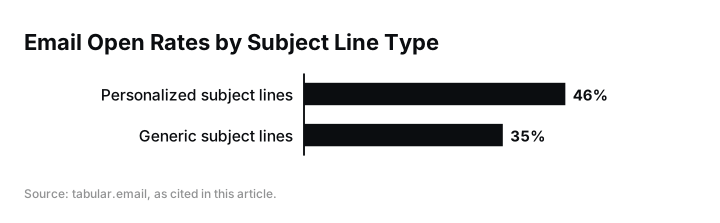
Personalized subject lines open more often than generic ones, showing how small choices compound over months of sending.
Capital Turbine's average open rate across ALL customers is 51%, nearly 3x the global average for marketing emails, and about 2x the average open rate for financial services marketing emails.
The List Is an Asset. Treat It Like One.
A prospect who finds your firm through a paid ad is one interaction away from forgetting you. A prospect on your email list is a relationship you can tend over time, at near-zero marginal cost. Every send builds familiarity. Every open builds trust. Every click tells you something about where that person is in their decision process.

A consistent email habit costs almost nothing to maintain once your list is built.
Ads get expensive to maintain. The moment you stop paying, the impressions stop. Your email list, on the other hand, is yours: an owned channel that no algorithm can throttle or reprice. It grows in value as it grows in size, and it never charges you more because demand went up.
This is why the advisors spending heavily on ads while ignoring email marketing are solving the harder problem first. They're working to build awareness with strangers while letting existing relationships go cold.
Where Ads Belong in the Mix
None of this is an argument against paid advertising. Ads genuinely do things email can't: they find people who have never heard of you, create visibility in new markets, and accelerate growth when you're ready to scale. The smartest advisor marketing strategies use both: ads to build the top of the funnel, email to work the middle and bottom of it.

Ads and email serve different stages of the funnel and work best when used together.
The mistake is treating them as substitutes. Running ads without email marketing means you're growing an audience you can't reach affordably. Running email marketing without ads means you're working a list that isn't growing. The channels reinforce each other. But one of them runs for essentially nothing once it's set up, and that one deserves your attention first.
Common questions
What is the ROI of email marketing compared to paid ads?
Email marketing delivers an average return of $36–$42 for every $1 spent, compared to roughly $2 for paid search and $2.80 for social media advertising. That makes email the highest-ROI digital marketing channel by a wide margin, returning 12 to 15 times more per dollar than its nearest paid competitor.
How often should a financial advisor send marketing emails?
Industry data points to 2–4 emails per month as a sound baseline for maintaining top-of-mind awareness without fatiguing your list. For advisors with a warm, opted-in audience, consistency matters more than frequency. One well-branded send per week is enough to stay present in your prospects' inboxes without overwhelming them.
Can I run email marketing and paid ads at the same time?
Yes, and the combination tends to outperform either channel alone. Paid ads are built for cold traffic: finding people who don't know you yet and expanding your reach. Email is built for warm audiences: staying relevant with the people who already know you and keeping your pipeline moving. Using both means you're growing your sphere of influence and nurturing it at the same time.
If you're thinking about how email fits into your overall marketing mix, we're happy to talk through how advisors are putting it to work. Reach out anytime.
Sources
Paid advertising delivers an average 200% ROI, or $2 for every dollar spent
Email returns 12 to 15 times more per dollar than its nearest paid competitor
Open rates in financial services reach 20–35% for broadcast email
Email drives conversion rates of 4.24% vs. social media at 0.59%
Personalized subject lines generate an average open rate of 46% versus 35% for generic ones