

email campaigns for financial advisors
The Email Newsletter Nobody on Your List Actually Reads
Capital Turbine · · 6 min read
The average financial advisor newsletter gets a 20–25% open rate, which sounds fine until you realize that 75–80% of your list looked at your subject line and decided it wasn't worth their time. Honestly, they were probably right. If your newsletter reads like a market commentary pulled from a wire service, a compliance-approved thought piece about "volatility," and a gentle reminder that you exist, your subscribers are trained to ignore it. Email isn't broken. Your email is broken.
The good news is that fixing it doesn't require a copywriting degree. It requires understanding why people open emails in the first place and what makes them actually read to the bottom.
The real reason advisors send generic newsletters
Here's the honest answer: because generic is safe and fast. You grab a market update from your custodian, attach your headshot, schedule it for Tuesday morning, and call it marketing. Compliance is happy. The box is checked.
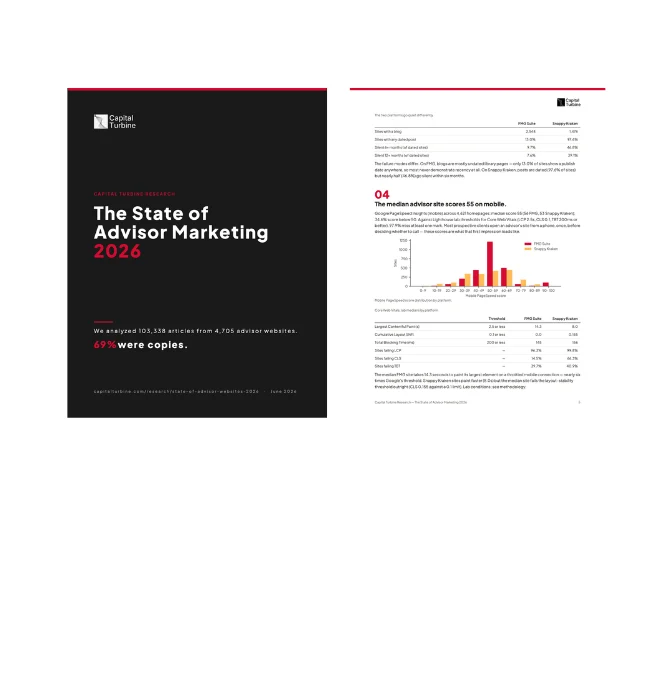
The problem is that your clients and prospects are getting identical emails from other advisors who want their business. We recently did a study which found that nearly 70% of articles and resources on advisor websites appear identically on at least one other site. Even worse, we found that over 50% of advisors have content on their website that is shared with at least 25 other firms.
Generic content doesn't just fail to differentiate you. It actively trains your audience to associate your name with content they don't need to open. You're paying for that habit every single time you hit send.
A well-known benchmark in email marketing is that it takes between six and eight touchpoints before a prospect takes meaningful action. If seven of those touchpoints are forgettable, you've wasted seven chances to earn trust.
What actually gets emails opened (and read)
Two things matter: relevance and voice. That's it. Every tactical trick (the emoji subject line, the personalized first name, the send-time optimization) is just noise if the underlying content isn't relevant to the specific person receiving it, written in a way that sounds like a human being they recognize.
Relevance means segmentation
A pre-retiree in their late 50s worrying about sequence-of-returns risk and a 38-year-old business owner thinking about a Solo 401(k) are not the same person. Sending them the same email about "what the Fed's latest move means for your portfolio" is a missed opportunity on both ends. When you segment your list (even into just two or three buckets based on life stage, client type, or where they are in your funnel) and tailor the message accordingly, open rates climb. Clicks climb. So does the likelihood that someone forwards your email to their brother-in-law who needs exactly what you do.
Voice means sounding like yourself
Your clients hired you. Not a content syndication service. The emails that consistently get the best engagement are the ones that feel like a message from a person, with a specific point of view, a story, maybe even a little humor. If your newsletter could have been written by any advisor at any firm, you've already lost. The subject line "What I told a client who panicked this week" will outperform "Q3 Market Outlook" almost every single time. One sounds like a conversation. The other sounds like a report.
The mechanics that kill good content
Even when the content is solid, the mechanics can sink you. A few specific things worth auditing right now:
Send frequency: Monthly is too slow to stay top of mind. Weekly is too fast if you can't maintain quality. Biweekly is the sweet spot for most advisors.
Mobile formatting: More than 60% of emails are opened on mobile. If your newsletter looks like a PDF printed in 2009, people are bouncing immediately.
One clear action: Every email should have one thing you want the reader to do: read an article, book a call, download a guide. Not five things. One.
Compliance routing: Slow compliance approval cycles are the silent killer of timely, relevant content. If your "what to know about this week's tax bill" email clears compliance three weeks later, it's useless. You need a workflow that moves fast without creating liability.
What a high-performing advisor email actually looks like
Think of your newsletter less like a publication and more like a short, direct message from a trusted advisor to a specific person. The best ones tend to follow a simple structure: a short, specific hook tied to something timely or personally relevant to that segment; two to three paragraphs of genuine insight (not a recap, but your actual take); and a single call to action that feels natural, not salesy.
Subject lines that perform well tend to be specific and human: "The question I keep hearing from clients right now" or "One thing to do before year-end if you're in the 32% bracket." Both of those tell the reader exactly what they're getting and make them feel like the email was written for someone like them.
The firms doing this well aren't spending more time on email. They're spending smarter time, usually with automation that generates personalized content in their voice, routes it through compliance, and schedules it for segments most likely to engage. The result looks effortless. It isn't, which is exactly why most advisors don't do it, and exactly why the ones who do stand out.
If your current email strategy consists of a monthly market update that goes to your entire list, we're happy to walk through what a better-segmented, more personal approach would look like for your practice. No pressure, just a real conversation about what's actually working.
Common questions
How often should a financial advisor send email newsletters?
Biweekly (every two weeks) is the most effective frequency for most independent advisors. It's frequent enough to stay top of mind without overwhelming your list or forcing you to produce low-quality content. Monthly works if each email is high-value and highly personalized, but it's too slow to meaningfully nurture prospects through a six-to-eight touchpoint sales cycle.
What email open rate should financial advisors expect?
Industry benchmarks for financial services put average open rates between 20% and 25%. Advisors who segment their list and write in a distinct, personal voice consistently outperform that range, with some achieving 35–45% open rates on well-targeted campaigns. Subject line specificity and send-time consistency both have measurable impact on open rates.
Do financial advisor emails need compliance approval before sending?
Yes. For RIAs and broker-dealer affiliated advisors, outbound marketing emails are considered "communications with the public" under SEC and FINRA rules and require pre-approval and record retention. The practical fix is a compliance routing workflow built into your marketing platform so approvals happen quickly and every email is archived with a full audit trail. Without that workflow, the compliance requirement often becomes an excuse to send less, and less timely, content.
This article is for educational purposes only and does not constitute financial, tax, or legal advice. Individual circumstances vary. Please consult qualified professionals for advice specific to your situation.