


Marketing automation for financial advisors has moved from experiment to expectation — and so has having a credible digital presence at all. Two major research releases in 2026 — AcquireUp's 2026 Industry Index published in March and the Kitces Research marketing study published in August — paint a detailed picture of where advisors are putting their time, what's working, and where manual effort is quietly destroying efficiency. Meanwhile, a shift in how prospects discover advisors is making a clean website, an active blog, and a consistent social presence no longer optional. In the age of AI search, your digital footprint either earns you a recommendation or costs you one.
Digital Marketing Has Become a Prerequisite, Not a Premium
There was a period — not long ago — when a polished website and regular content were markers of an ambitious advisor, not a standard one. That period is over. 96% of prospects research financial advisors online before choosing one, even when referred by a friend or CPA. That number alone reframes what "optional" means for digital marketing.

A professional digital presence now shapes whether prospects trust an advisor before any conversation begins.
The shift accelerated because of AI. Prospects are no longer just Googling "financial advisor near me." A quarter of affluent Americans already use AI tools like ChatGPT, Gemini, or Claude to find financial advisors, according to the Wealthtender 2025 Study of $100K+ Households Seeking Financial Advice. Those tools pull from what's already indexed and credible online — your website content, your blog posts, your social footprint. If that content is thin, outdated, or absent, AI search doesn't find you. As Financial Planning noted in September 2026, advisors who once counted on steady warm leads from Google search "may discover that they're not even on the radars of ChatGPT, Claude, Gemini and other AI tools."
This means the stakes for digital marketing execution have changed. A mediocre website with no blog is no longer just a missed opportunity — it's a liability in an environment where AI is increasingly the first stop for your next client.
The AcquireUp 2026 Industry Index: Automation Is the Growth Strategy
In March 2026, AcquireUp released its 2026 Industry Index based on survey data from more than 500 financial professionals. The numbers are direct. When asked how they plan to scale their businesses, 41% of advisors said they plan to automate processes — marketing, communication, and client engagement — rather than expand internal teams. That tied with a focus on high-net-worth clients as the most common scaling strategy cited.
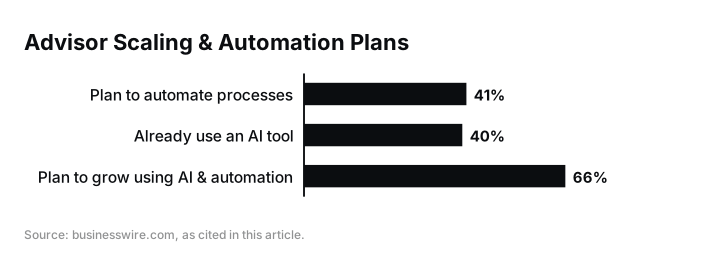
AcquireUp survey data shows the share of advisors already using AI tools and those planning automation-led growth strategies.
The same index found that 66% of financial professionals plan to grow their client base within the next three years using technological systems, AI, and automation. Forty percent already report using an AI tool, primarily for marketing support and client communications. If two-thirds of your competition is building automated growth infrastructure, the window to get ahead of it is narrowing.
AcquireUp's CEO Greg Bogich put it plainly in the report's announcement: advisors "don't have a lead problem, they have a consistency problem." The fastest-growing practices are building repeatable systems powered by data, AI, and automated follow-up — not relying on effort alone.
The 2026 Kitces Report: Advisor Time Is the Budget Line That Matters
The Kitces Research marketing study, published in August 2026, surveyed 506 qualified financial advisors about their 2025 marketing activity. It's the most detailed look at advisor marketing economics available, and the findings challenge some assumptions about where advisors should be spending their time.

Advisors building repeatable, automated systems are gaining a structural edge over those relying on manual effort alone.
The most important number in the report may be this one: advisor time accounted for approximately 60% of total marketing costs in 2026. Your hours are the most expensive input in your marketing budget — which means anything you're doing manually that could run on autopilot is a real cost, not just an inconvenience.
On efficiency, there's good news. The typical practice's revenue acquisition cost dropped from approximately $1.08 in 2024 to around $0.70 in 2026 for every $1 of new annual client revenue. Advisors are narrowing their tactics and spending less time to get the same or better results. That's the direction automation pushes any practice.
What the Data Says About Which Channels Work (and Which Don't)
The Kitces report is particularly clear about social media's economics. 82% of financial advisors using social media reported getting zero new clients directly from it over the previous 12 months. Social media ranked worst among measured tactics on pure economics, at $4.88 per new revenue dollar generated. Those numbers are worth taking seriously — but they describe a direct attribution problem, not a reason to pull back. Social media doesn't always get credit for bringing in a client, even when it helped influence the decision.
The more useful frame is this: social media has matured from an optional visibility channel to core business infrastructure. Prospects evaluate advisors long before scheduling a call — reviewing profiles, scanning recent posts, assessing consistency, and gauging credibility through digital presence. Social media is now where that evaluation starts, and what a prospect finds online either confirms the referral that sent them or quietly ends it. A missing or dormant social presence is a gap that raises doubt at exactly the moment a referred prospect is deciding whether to reach out.
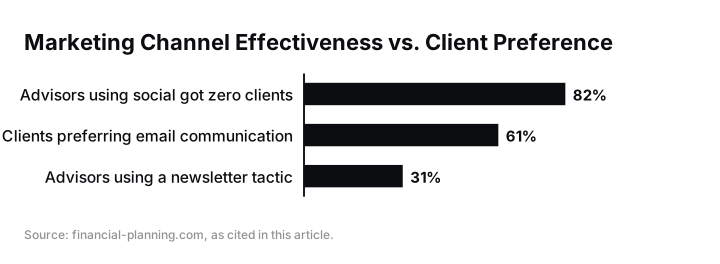
Survey data highlights the gap between where clients prefer to receive communication and where most advisors are actually present.
The distinction the data supports is between presence and pipeline. A consistent social presence — a coherent brand, a clear niche, a regular cadence of posts that reflect your expertise — builds the familiarity and credibility that precede a client relationship. That influence often goes uncredited in direct attribution. The right use of social media is to build familiarity, demonstrate expertise, and support relationships — not to treat it as a standalone lead-generation channel and measure it accordingly. Posting sporadically or inconsistently is worse than a reduced but coherent presence, because inconsistency signals to prospects exactly what they don't want to see from someone managing their finances.
Email tells a different story. According to a 2024 YCharts survey, 61% of financial services clients prefer email as their primary communication channel with their advisor. Client preference is the floor for any channel prioritization decision. And yet the Kitces 2026 report found that only 31% of advisors use a newsletter as a marketing tactic — leaving a meaningful gap between where clients want to receive communication and where many advisors are actually showing up.
The Kitces data also found that high-growth advisory practices are far more likely to have a defined niche than the broader advisor population. A clear niche makes every automated marketing sequence more specific, more relevant, and more likely to resonate with the right prospect at the right time. It also makes you more visible in AI search: AI tools are designed to match advisors to specific client profiles, and a well-defined niche gives them the specificity they need to surface you.
Your Website and Blog Are Now AI Discovery Infrastructure
In the old world, your website was a digital business card. Prospects landed on it after a referral to verify you were legitimate. That role hasn't disappeared — 72% of prospects visit an advisor's website during research, and 67% cite a professional site as a trust factor — but the website now plays an additional role that most advisors haven't accounted for yet.
AI tools like ChatGPT, Claude, and Gemini pull from publicly indexed content when forming recommendations. Research shows that top-ranking websites are most likely to appear in AI-generated summaries. Your blog posts, service pages, and FAQ content are the raw material those tools use to understand what you do, who you serve, and whether you're worth citing. An advisor with no blog and a generic five-page website gives AI search almost nothing to work with. An advisor with consistent, niche-specific content — published regularly and structured for search — gives AI the context it needs to recommend them.
The advisors closing the efficiency gap in 2026 aren't just automating tasks — they're building systems where a clean website, regular blog content, and consistent social presence function together as discovery infrastructure for both Google and AI-powered search.
The Compliance Layer That Makes or Breaks Automation
Automation in financial services carries a compliance dimension that generic tools don't address. FINRA Rule 2210 governs what advisors can say in communications with the public, and any automated sequence that goes out without a compliance review process creates regulatory exposure. The value of a marketing automation system for an advisor isn't just speed and personalization — it's whether compliance approval is built into the workflow or bolted on afterward.

Compliance review built into the automation workflow eliminates the friction that generic tools reintroduce.
Advisors using generic automation platforms typically manage compliance review as a manual step outside the system. That re-introduces the exact friction automation was supposed to remove. The practices getting the most out of automation in 2026 are those using systems where compliance routing and archiving are part of the native workflow, not workarounds appended to it.
What This Means for Independent Advisors Right Now
Three things stand out from the 2026 data that independent advisors should take seriously heading into 2027.

Independent advisors who consolidate their marketing into connected systems hold a measurable structural advantage heading into 2027.
First, your digital presence has a new job. A website that was adequate for Google search in 2023 may be invisible to AI search in 2026. If your site lacks structured content, a consistent blog, or clear signals of your niche and expertise, AI tools have little to cite when a prospect asks for an advisor like you.
Second, the advisors narrowing their marketing tactics are outperforming those spreading thin. The Kitces data found the typical number of tactics used dropped from five to four among advisors surveyed in both 2024 and 2026. Fewer channels, done consistently and well, outperform more channels executed manually and inconsistently.
Third, time is the real cost. If advisor hours make up roughly 60% of your marketing budget, the ROI on any system that reduces manual content production, compliance routing, and follow-up work is measurable in real dollars — not just efficiency gains on paper. An advisor running a fully connected system — website, email nurture, blog, social, and advertising on a single platform — has a structural advantage over one stitching together five separate tools and managing compliance reviews by hand.
Common questions
Why is a clean website and blog now considered essential for financial advisors, not optional?
Prospects have always researched advisors online — 96% do so before choosing one, even after a referral. What's changed is that AI tools like ChatGPT, Claude, and Gemini now mediate a growing share of that discovery. A quarter of affluent Americans already use AI to find financial advisors, according to the Wealthtender 2025 study. Those tools surface advisors based on publicly indexed website content, blog posts, and social presence. An advisor with thin or outdated content gives AI search almost nothing to work with, which means they risk being overlooked entirely in this channel.
What percentage of financial advisors are using marketing automation in 2026?
According to AcquireUp's 2026 Industry Index, which surveyed more than 500 financial professionals, 40% of advisors currently use an AI tool primarily for marketing support and client communications. Additionally, 41% said they plan to automate processes as their primary scaling strategy, and 66% plan to grow their client base using AI and automation within the next three years.
Which marketing channels deliver the best ROI for financial advisors?
The 2026 Kitces Research marketing study found that social media ranked worst on pure economics at $4.88 per new revenue dollar, and 82% of advisors using it reported zero new clients directly from it. Email has stronger client-preference data — 61% of financial services clients prefer email as their primary communication channel with their advisor, according to a 2024 YCharts survey. Referrals and niche-focused content paired with SEO tend to show stronger efficiency ratios in the Kitces data, and both also contribute to AI search visibility in ways that paid social alone does not.